How to host a trivia night
Everything you need to run a good quiz evening for friends, family or colleagues: the format, the questions, the scoring, and the awkward moments you can plan for.
Create a room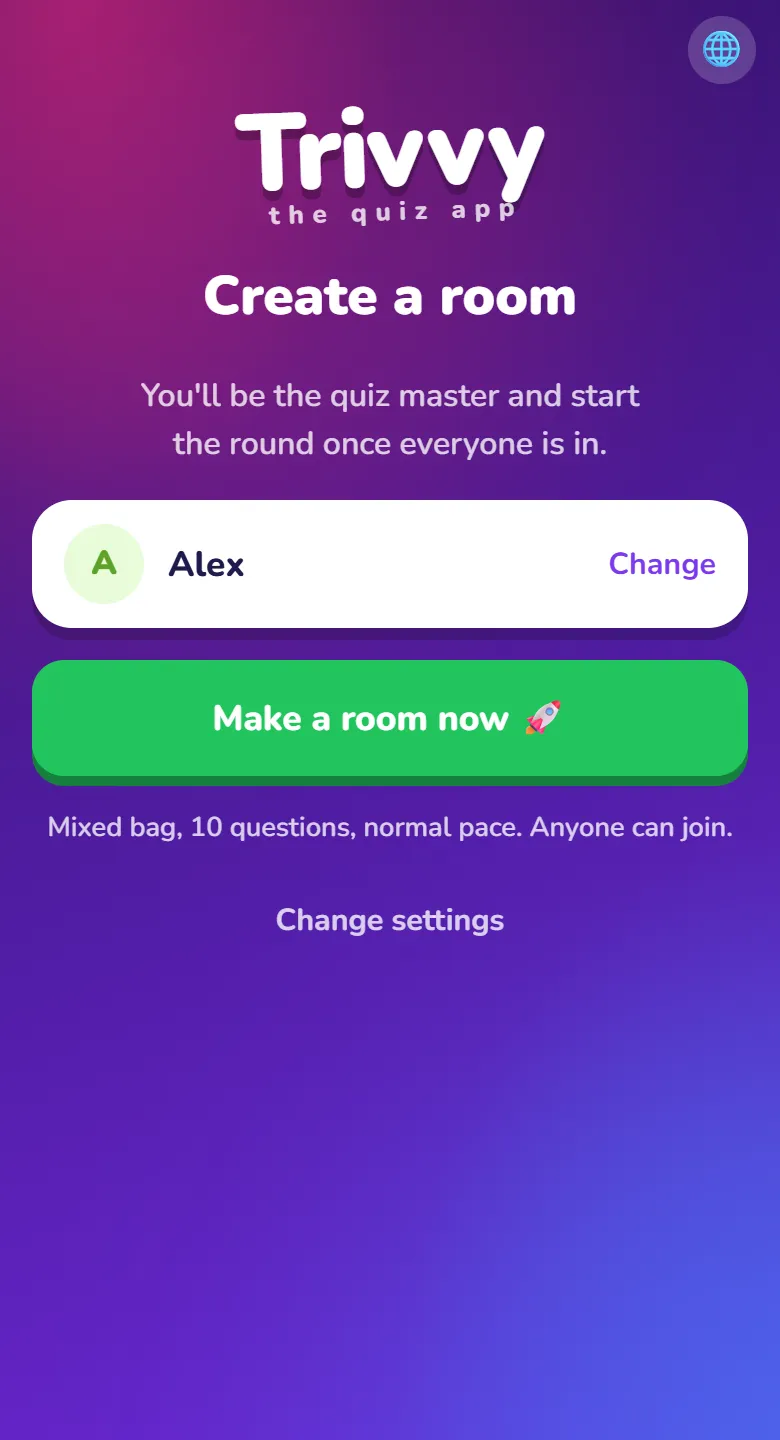
Start with the people, not the questions
A good trivia night is decided before the first question is read. Think about who is coming. A table of colleagues who barely know each other needs easier questions and a bit of mixing; a group of old friends will happily argue about an answer for ten minutes. Children in the room mean shorter rounds and questions about things they actually meet, such as animals, films and food.
Then decide whether people play alone or in teams. Teams of three to five are the classic pub format because the quietest person can still contribute an answer nobody else knew, and nobody feels exposed by a wrong guess. Playing alone is simpler to score and more competitive. If your group is mixed, individual play on phones with a shared scoreboard works well, because there is no single loud voice deciding for a team.
Pick a format and a length
Two hours is plenty for most groups, including the time spent arriving, getting a drink and arguing about answers. Split the evening into rounds of about ten questions with a short break between each. Rounds give the night a rhythm and a natural place to announce the scores, and they let you change gear: start with an easy general round, move to a themed round such as film or geography, and finish with something harder.
A round of ten is long enough to feel like something and short enough that a bad round is quickly over. If you only have an hour, two rounds of ten or one of twenty is a good size. Trivvy offers rounds of ten, twenty or thirty questions for the same reason, with thirty, sixty or one hundred and twenty seconds per question depending on how much thinking and typing you want.
Choose or write the questions
You can write your own or use a ready-made bank. Writing your own gives the night a personal flavour, and a round about the people in the room is always popular. If you do, keep to one clear answer per question and avoid anything that can change, such as who currently holds a title. Our guide to writing trivia questions goes through the pitfalls in detail.
A ready-made bank saves hours and removes the awkward position of the host knowing all the answers in advance. Whichever you use, mix difficulty on purpose. A useful rule of thumb is that most questions should be ones a quarter to a half of the room can answer, with a few easy ones to build confidence and a few hard ones to separate the top of the table.
Run the evening
Explain the rules once, at the start, and keep them short: how many questions, how long each one gets, how answers are marked and what happens with ties. Write the key points where everyone can see them. Read each question clearly twice if you are speaking aloud, and give a moment of silence before moving on.
Keep the pace up. The most common way to ruin a quiz night is a host who pauses to chat for five minutes after every question. A steady tempo of one question every minute or so keeps everyone in the game. Save the conversation for the breaks, and let the answers spark the stories rather than the other way around.
Handle the awkward moments
Plan for the three things that go wrong: a disputed answer, a tie and someone checking their phone. For disputes, decide beforehand who has the last word. In a Trivvy room, a player who thinks an answer was judged wrongly can dispute it while the solution is shown, and the others in the room vote; the majority decides whether the point is given. Doing it that way takes the host out of the firing line.
For ties, finish with a tie-breaker question where the answer is a number and the closest guess wins. And for phones, the easiest solution is to play on them: when the quiz itself lives on the phone, there is nothing to cheat with, because everyone types their own answer at the same moment and the answers are only revealed after the question has closed.
Hosting it with Trivvy
Create a room, choose the categories, the difficulty, the number of questions and the time per question, and share the four-character code or the link. Friends join on their own phones without an account. In the lobby everyone can see who has arrived, and you start the round when you are ready, or set a countdown so it starts by itself. You can also schedule a room up to seven days ahead and add it to your calendar.
Everyone gets the same question at the same time and types an answer. The solution appears with everyone's answers, you can react with an emoji, and after the final question you get the podium, the full standings and a few awards such as the longest streak and the fastest answer. Then play another round in the same room. Because players do not need to be in the same place, the same setup works for friends who live in different cities.
A warm-up round you can use
Here are eight easy questions to open an evening with. Read them out, or paste them into your own quiz. They are written for this guide and are not taken from the Trivvy card bank.
How many minutes are there in two hours?
Show answer
120
Which month has 28 days in most years?
Show answer
February
How many hours are there in a week?
Show answer
168
What is the Roman numeral for 50?
Show answer
L
How many minutes are there in a quarter of an hour?
Show answer
15
A group of five musicians playing together is called what?
Show answer
A quintet
How many sides does a pentagon have?
Show answer
Five
What do you call the speed unit used at sea, equal to one nautical mile per hour?
Show answer
A knot
More ways to play
- Trivia with friends
- Daily trivia
- Halloween trivia
- Christmas quiz
- Advent calendar trivia
- Speed trivia (Quiz Rush)
- Trivia battle (1v1)
- Road trip trivia (30 questions)
- Trivia challenge
- Quiz grid
- Daily 4x4 trivia grid
- General knowledge test
- Halloween trivia questions
- Christmas trivia questions
- General knowledge quiz questions
- Family trivia questions
- Trivia rules and scoring
- Is trivia good for your brain?
- How we check our questions
- Car ride trivia
- How to write trivia questions
- Categories and difficulty levels
- Trivvy game formats explained