Trivia categories and difficulty levels explained
Picking categories and difficulty is the most important choice you make when you create a quiz. Here is what each option contains and how to match it to the people playing.
Create a room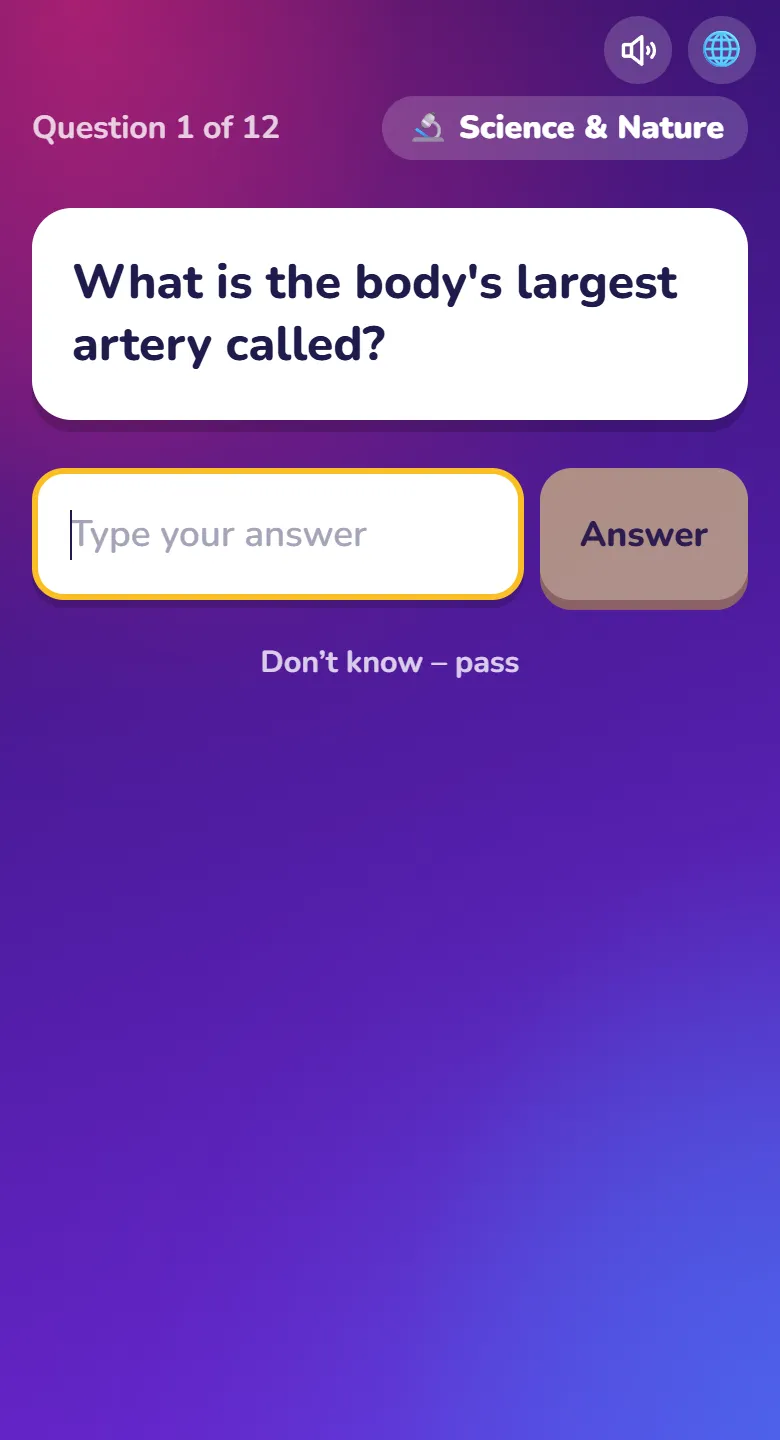
The six main categories
Geography, entertainment, history, arts and literature, science and nature, and sports and leisure are the six main categories. Together they cover what most people mean by general knowledge, and a round from all six is the safest choice for any group, since almost everyone knows something in some of them.
Choose the category “Mixed bag” if you want exactly that. It draws from the six main categories and takes turns between them, so the round feels balanced. It deliberately does not include the niche categories below, because those are written for fans and would make a general round uneven.
Niche categories for fans
Niche categories are for a group that shares an interest: nerd culture, film, music, animals and nature, food and drink, Premier League football, books, TV series, video games and cars. They are only played when someone chooses them. The difficulty is also calibrated for fans: an easy question in a niche category is one that someone who plays or follows the subject a little would know, a medium question is one that a real enthusiast knows, and a hard one is deep trivia.
Niche rounds are excellent for themed evenings, a film night with the cast of a series, or a mixed group where you want one round with a different flavour.
Seasonal categories
There are categories for the seasons of the year: Halloween, Christmas, Valentine's Day, Eurovision and summer. The Halloween and Christmas rounds are a good fit for a party or a family evening, and you can read more about them in our Halloween trivia and Christmas quiz pages. There is also an NFL category, offered to players in the United States.
Countries
If you pick a country, you get questions about that country across all topics: history, geography, culture, sport and everyday life, written for people who know the country. Trivvy has more than a dozen to choose from, including Norway, Sweden, Denmark, Germany, the Netherlands, the United Kingdom, the United States, Ireland, Australia, Canada, France, Belgium, Spain and Argentina. A country round is a good choice when your group shares a nationality, or when you want to test what you know about a place you are about to visit.
Combining categories
You can choose several categories for the same room or challenge. The round then takes turns between them, so history plus a country is every second question from each. That is the easiest way to make a quiz that fits a particular group: for example, film plus music plus Mixed bag for a night with friends who like popular culture.
What the difficulty levels mean
Every card is easy, medium or hard. Easy is what most people know, medium is what a good part of them know, and the rest can reason their way to, and hard is for people who are interested in quizzes. You can choose one level, or “Mixed”, which is the default for most players: out of ten questions, about six are easy, three are medium and one is hard, with the easy ones first so a round starts gently.
For a group of mixed ages or experience, Mixed is almost always right. Choose easy for children or for a relaxed evening, and hard when you are playing with people who already do quizzes regularly and want a challenge.
Matching the categories to the occasion
For a family evening with different ages, use Mixed bag on easy or Mixed difficulty. For a party with friends who share a hobby, pick the niche that matches it, perhaps with one general category added so that everyone has a chance in some rounds. For a birthday or an office night, a combination of a main category and a country gives a personal touch without needing any preparation.
If you play alone, the daily quiz gives five general questions a day, and Quiz rush gives as many questions as you can answer in three or five minutes. Both pick from the same cards, so what you learn in one helps in the other.
A short checklist before you press start
Who is playing, and what do they know? Do they share an interest or a country? How long do you have: ten, twenty or thirty questions? How much time do people need per question, thirty seconds, a minute or two minutes? Answer those four questions and the settings almost choose themselves.
Finding your own level
If you want to know where you stand, the level test is twelve questions that set your level in each main category. After that, the longer solo rounds and Quiz rush choose questions at about the right difficulty for you, so the game stays challenging without being too hard.
More ways to play
- Trivia with friends
- Daily trivia
- Halloween trivia
- Christmas quiz
- Advent calendar trivia
- Speed trivia (Quiz Rush)
- Trivia battle (1v1)
- Road trip trivia (30 questions)
- Trivia challenge
- Quiz grid
- Daily 4x4 trivia grid
- General knowledge test
- Halloween trivia questions
- Christmas trivia questions
- General knowledge quiz questions
- Family trivia questions
- How to host a trivia night
- Trivia rules and scoring
- Is trivia good for your brain?
- How we check our questions
- Car ride trivia
- How to write trivia questions
- Trivvy game formats explained