Trivvy game formats explained
Trivvy has many ways to play, because quiz players want different things. This guide lists every format, how it is played, and what it suits.
Pick a game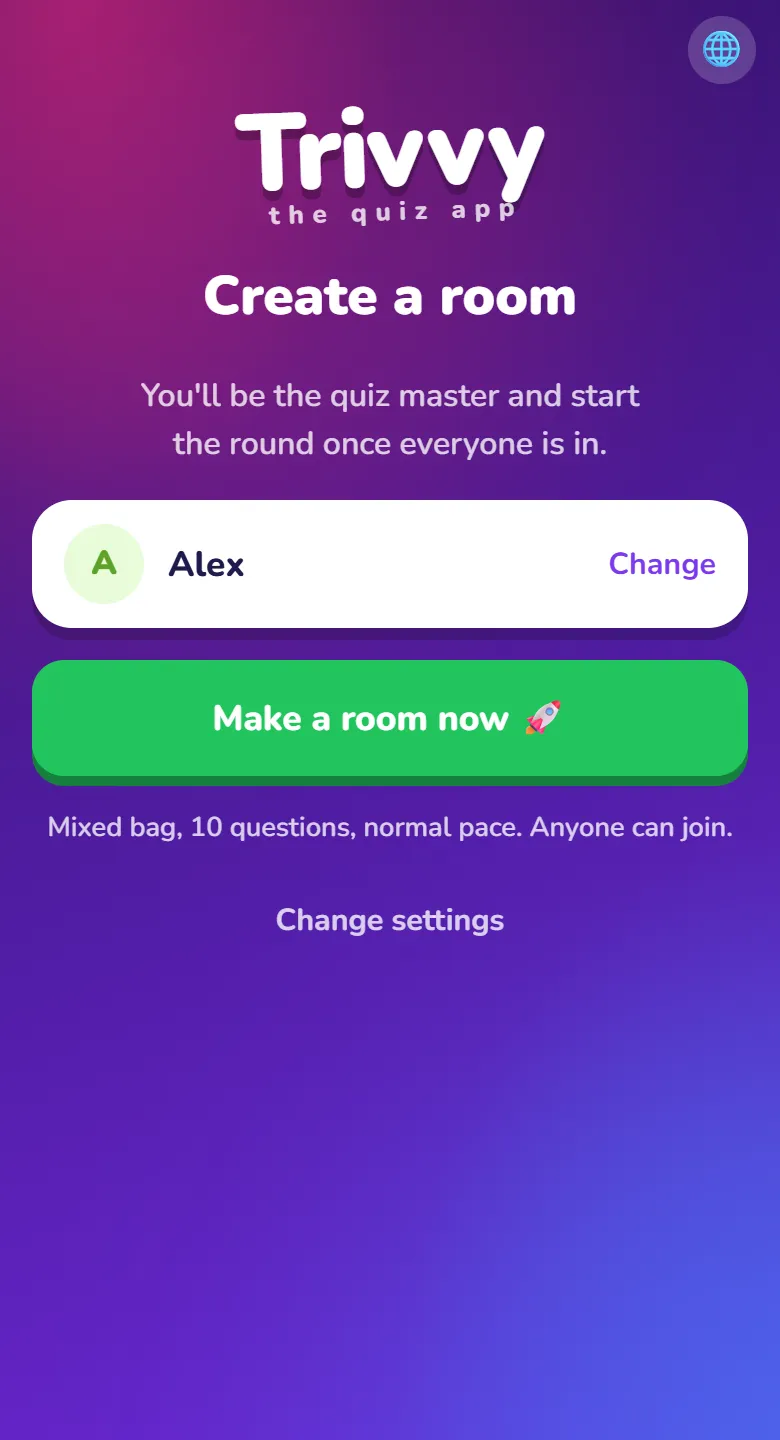
Room with friends
The classic format. One person creates a room and becomes the quiz master, choosing the categories, the difficulty, the number of questions (10, 20 or 30) and the time per question (30 seconds, one minute or two minutes). Friends join with a four-character code or a link, and everyone gets the same question at the same time and types an answer on their own phone. The question closes when time runs out or when everyone present has answered. Each correct answer gives one point.
After each question the solution appears with everyone's answers, and you can react with an emoji. If you think an answer was judged wrongly, you can dispute it and the others vote. At the end there is a podium, the full standings and awards. The room can be public, listed on the front page until the round starts, or only for people with the code, and the quiz master can set a start time up to seven days ahead, with a calendar file to download. It suits parties, family evenings and friends playing from different places.
Hint mode
Hint mode is an option when you create a room. While the clock runs, the letters of the solution appear one by one from the start, never more than three and never more than half of the answer. An answer before the first hint is worth four points, and each hint that has appeared takes one point off, down to a minimum of one. It rewards the player who knows the answer early, and it suits groups that want a faster, more competitive round.
Trivvy Live
Trivvy Live is a room with no host that anyone can join. A new round starts every hour and every half hour, with 20 questions of 30 seconds each. Take a seat and play something else while you wait; the app brings you back when the round starts, and you can ask for a notification two minutes before. A round needs at least two players to start. If nobody else turns up, you are offered a replay of an earlier round instead. It suits someone who wants to play against other people right now, without arranging anything.
Quiz battle
Quiz battle is a one-against-one race. You choose three or five minutes and join the queue, and the app pairs you with the waiting player whose rating is closest to yours. You both get the same questions and three lives, and a wrong answer costs a life. When the clock runs out or the lives are gone, the player with the most correct answers wins. You can see your opponent's points and lives while you play, but never their answers. If no opponent is found after a short wait, you can play against a recording of a real round, and afterwards you can ask for a rematch.
Quiz challenge
A challenge is a normal quiz played at different times. You choose a category and 5, 10 or 20 questions, and send the link to the people you want to challenge. Everyone gets the same questions and plays when it suits them. Each person can take a challenge once, the link does not show anyone's score, and you see the standings when you have finished your own round. A challenge stays open for a week. It suits friends and colleagues who are never online at the same time, and teachers who want a class to answer the same set.
Quiz grid
Quiz grid is a buzzer game for two to four players, each on their own phone, with a five-letter room code. The board has four columns of categories and four or five rows of questions worth 100 points and up. Whoever picks a square reads the question with the others; then the button opens, and the first to press it types the answer. As in Jeopardy, a wrong answer costs as much as the square is worth, and the others get another chance. One square is a hidden double, where the player who finds it stakes some of their points.
The pace is set by the clock: the player to choose has 60 seconds before the app picks a square, the button is open for ten seconds, and the player who pressed has fifteen seconds to type. It suits a small group that wants a fast, competitive game with a bit of bluffing about what you dare to press.
Family game
The family game is played in turns around the table. One person creates the room and gets a five-letter code. Each phone can hold one or more players, so a child without a phone can play from a grown-up's. Every player gets questions at their own level, so a child can beat an adult. Only the phone of the player whose turn it is can answer. You can pass, or say the answer aloud, and then a grown-up on another phone decides whether it was right. A room has between one and ten rounds, and no ads are shown if a child is playing. It is the newest format, and we are still fine-tuning it.
Daily quiz
The daily quiz is five questions that are the same for everyone, with a new set after midnight Norwegian time. You get one minute for each question and see the solution after each answer. You can play it once a day, and playing several days in a row builds a streak. With an account you also appear on the leaderboard for the day. It takes a couple of minutes and suits a daily habit.
Quiz rush
In Quiz rush you choose three or five minutes and answer as many questions as you can. You have three lives, and every wrong answer costs one. The questions start easy and get harder. To keep it fast, the answers are judged on the spot using fixed rules: the solution, variants and typos are accepted, but rephrasings are not. After the round you see your points, your longest streak and the hardest question you got right. It suits a short break and a quick round alone.
30 questions
30 questions is the long round: thirty questions at your own pace with no clock and no lives. You see the solution after each answer and move on when you are ready. If you close the page halfway, you can continue in the same browser. It was made for long car rides and for evenings when you want to keep going.
Daily 4x4
Daily 4x4 is the grid game for one player. There is one board a day, the same for everyone: four categories with four questions each. You pick a square and answer it yourself, and there is no clock. A wrong answer costs nothing, except on the hidden double. You get one round a day, and you can share your result as a grid of marks without giving away any answers.
Seasonal quizzes
There is a quiz for each of five seasons: Halloween, Christmas, Valentine's Day, Eurovision and summer. Each is a round of 20 questions, with twelve easy, six medium and two hard questions, played at your own pace like 30 questions. They are promoted in season, for example Halloween from 1 October to 2 November and Christmas from 1 December to 6 January, but the pages work all year, and the same categories can be chosen in rooms and challenges.
Level test
The level test is twelve questions that find your level before you start: two questions in each of the six main categories. Get the first right and the second is harder; get it wrong and it is easier. The result sets your starting level, so that 30 questions and Quiz rush choose questions that fit you. You can retake the test after 30 days.
Ghost rounds
A ghost round is a real round that others played earlier, replayed for you: the same questions, with the other players' answers coming in at the same pace as when they were given. They appear only as Player 1, Player 2 and so on. You find ghost rounds in the lobby, and they do not give rating. They are the way to play a room-style round at any time of day.
Rating and leaderboards
With a free account you get a rating per category when you play in rooms with other players, starting at 800 and moving after each round depending on how you did against the others. Quiz battle has its own rating, which applies to guests as well. A separate knowledge rating measures you against the questions themselves: after about thirty answers, 30 questions and Quiz rush start choosing questions near your level. The leaderboards show the best players of the daily quiz and the highest-rated players in each category.
Which format should you pick?
For friends at the same time, a room. For people who are never online together, a challenge. For a quick fix alone, the daily quiz or Quiz rush. For a long drive, 30 questions. For a head-to-head against a stranger, Quiz battle. For a small group that likes buzzers, Quiz grid. For the whole family around a table, the family game. And if you are not sure where to start, tap the green button on the front page.
More ways to play
- Trivia with friends
- Daily trivia
- Halloween trivia
- Christmas quiz
- Advent calendar trivia
- Speed trivia (Quiz Rush)
- Trivia battle (1v1)
- Road trip trivia (30 questions)
- Trivia challenge
- Quiz grid
- Daily 4x4 trivia grid
- General knowledge test
- Halloween trivia questions
- Christmas trivia questions
- General knowledge quiz questions
- Family trivia questions
- How to host a trivia night
- Trivia rules and scoring
- Is trivia good for your brain?
- How we check our questions
- Car ride trivia
- How to write trivia questions
- Categories and difficulty levels